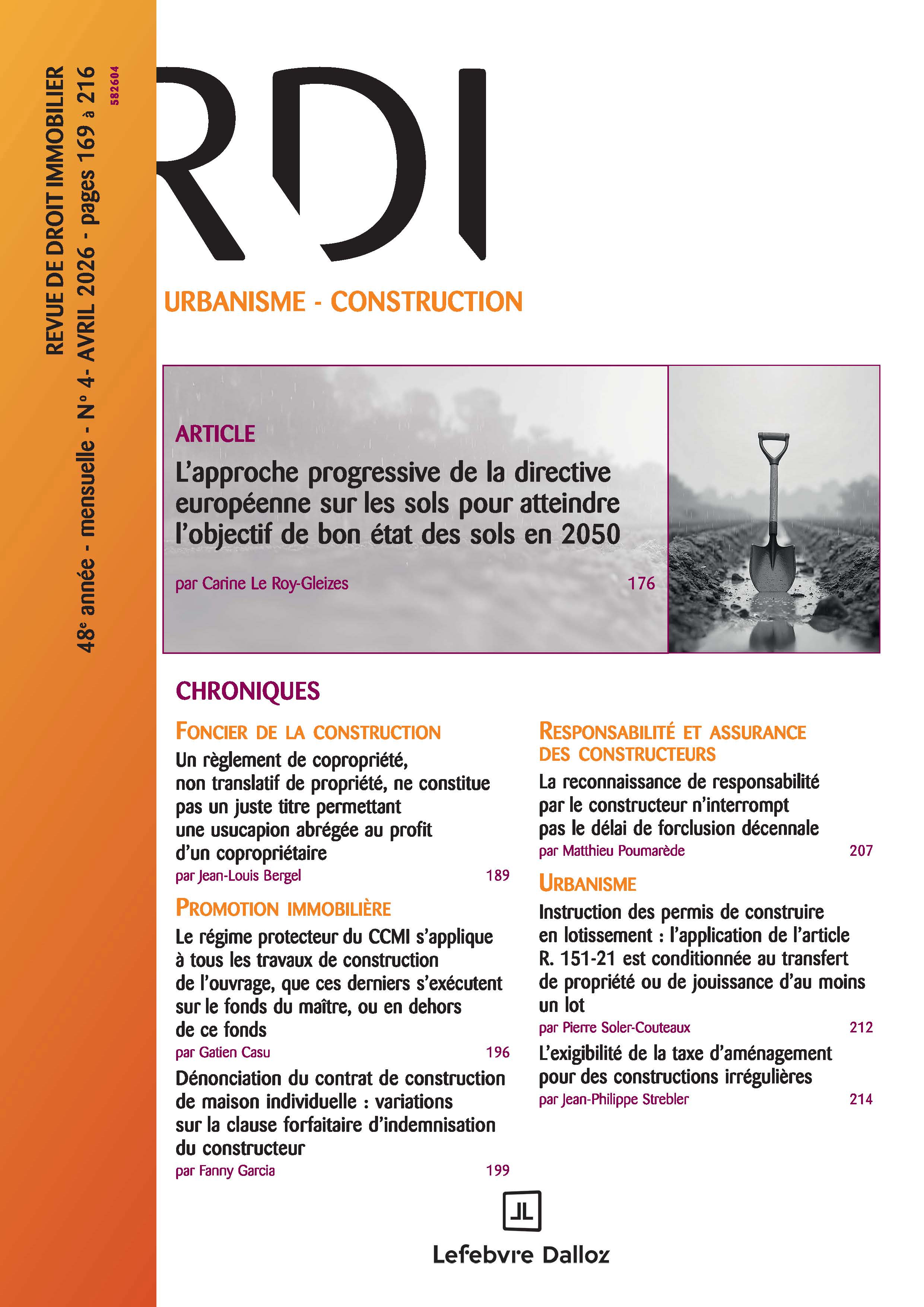
Revue de Droit Immobilier – April 2026 – The European Soil Directive’s progressive approach to achieving good soil status by 2050
Unlike air[1] and water[2], for which general rules of protection exist at European level, soils were the great untouched of environmental standards. Although a draft framework directive was presented as early as 2006, and finally withdrawn in 2014 under pressure from certain Member States[3], it is estimated that 60 to 70% of soils in the European Union are degraded. Artificialization, acidification and erosion are all phenomena that affect the many ecosystem services they provide, not only for food production but also for water regulation, carbon storage and biodiversity preservation. Soil pollution also has a definite impact on human health and the environment. Overall, soil degradation costs tens of billions of euros a year.
Coming into force on December 16, 2025, and to be transposed into national law by December 17, 2028[4], Directive no. 2025/2360 of November 12, 2025 on soil monitoring and resilience[5] fills this legal void. It focuses on three areas: soil health monitoring and assessment, soil resilience and contaminated site management. Setting the ” aspirational ” goal of achieving good soil status by 2050, the Commission envisages a step-by-step approach. Based on the observation that it is difficult to protect what cannot be measured, this text aims first and foremost to provide a common language for member states by establishing a coherent monitoring framework at EU level, based on reliable and comparable data.
France, like other countries, already has an ambitious framework for monitoring and managing contaminated sites, which does not require transposition of all the provisions of the text. Moreover, the text does not lay down any obligation of result, and dispenses with the sanctions originally provided for in the Commission’s proposal, as well as the distinction between sustainable and soil-damaging management principles. Adopted in a tense political and economic context with regard to additional standards, the directive is the fruit of a limited compromise compared to the 2006 draft directive. While this text undeniably marks an innovative first step, it also opens up a vast, long-term project, the concrete operational consequences of which will gradually become apparent.
[1] Directive (EU) No. 2024/2881 of the European Parliament and of the Council of October 23, 2024 on ambient air quality and cleaner air for Europe.
[2] Directive 2000/60/EC of the European Parliament and of the Council of October 23, 2000 establishing a framework for Community action in the field of water policy.
[3] Despite the support of a majority of member states, the proposal was persistently blocked in the Council by a qualified minority comprising the UK, Germany, France, the Netherlands and Austria. The European Commission therefore withdrew the proposal in 2014, without any official motivation. See Y. Chen, “Withdrawal of European Soil Framework Directive: Reasons and Recommendations”, Journal of Sustainable Development, vol. 13, no. 1, 2020, pp. 1-9
[4] SMRL, art. 26
[5] Directive (EU) No. 2025/2360 of the European Parliament and of the Council of November 12, 2025 on soil monitoring and soil resilience
Lawyers concerned by this news


Max Mietkiewicz
+ 33 1 56 69 70 00
m.mietkiewicz@uggc.com